The Pale Horse séance
The Pale HorseThe Pale Horse séance is the point at which Mark Easterbrook’s skeptical investigation becomes a disturbing firsthand encounter with Thyrza Grey’s methods. In a converted barn arranged for ritual, Thyrza directs Sybil Stamfordis through a performance that joins patterned ceremony, a live white cock and a humming electrical machine. Mark begins by seeing theatrical trappings; by the end, he feels the scene’s psychological force and recognizes that Thyrza is using Sybil for a definite purpose.
From ordinary arrival into a set-apart space
Mark’s arrival at The Pale Horse offers little of the sinister atmosphere he had anticipated. Thyrza, in a plain dark wool dress, greets him briskly and proposes supper as if welcoming an ordinary visitor. Her matter-of-fact manner makes the transition into the séance more striking: the event does not begin with overt menace but with a routine reception that gives way, step by step, to a different order of activity.
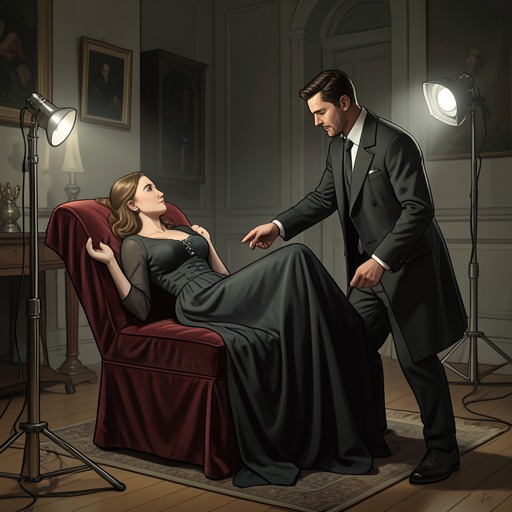
After supper, Thyrza leads Mark outside to the converted barn. There is no entrance from the house, so they cross the dark, overcast night before emerging into the long, lighted room. By day it had seemed a pleasant library; now its indirect, cold light falls on a raised divan covered with purple cloth embroidered with cabalistic signs. A brazier and an old copper basin stand to one side, while a heavy, oak-backed chair waits near the wall. The room’s objects and arrangement mark a separation from domestic space without changing the barn’s outward identity.
The change in Thyrza’s authority
Thyrza directs Mark to sit. Her manner changes, though he cannot define the change precisely. He senses not the spurious occultism he associates with Sybil, but the emergence of a more serious and purposeful woman, like a surgeon approaching a dangerous operation. This comparison gives the ceremony an unsettling double character: it is presented as occult practice, yet its leader behaves with the practical concentration of someone preparing a procedure.
Thyrza takes a long overall from a cupboard and puts on long mesh-like gauntlets. She explains that precautions are necessary. Mark finds the remark sinister, even as he continues to judge the room’s theatrical arrangements critically. His skepticism does not protect him from apprehension; he is aware of an emotional unease beneath his dismissive view of the mise en scène. The contrast establishes the séance’s central tension: its visible forms can look contrived while still exerting an effect on the person witnessing them.
Sybil, ritual, and the machine
After a pause in the music, Sybil speaks in a deep male voice, unlike her own manner of speaking, and identifies the presence as Macandal. Bella Webb moves through the shadows. Thyrza asks whether the spirit is Macandal, then later explains to Mark that ritual can affect the human spirit through words and forms sanctified by time and use. She compares that effect with the mass hysteria of crowds: its workings may not be fully understood, she argues, but the phenomenon exists. The explanation frames ritual as an instrument of human influence, not simply as decorative superstition.
Bella returns carrying a live white cock. She draws signs in white chalk around the brazier and copper bowl, places the struggling bird with its beak on the curved line, and finds it motionless there. As Bella chants in a low, guttural voice and sways over the markings, the ceremony becomes bodily and concrete. The animal, chalk, fire vessel, basin and human gestures give the ritual a material sequence, even though Mark cannot understand the words.
Thyrza then opens what Mark had taken for a radio cabinet. Inside is a complicated electrical contrivance mounted so that it can be wheeled across the room. She moves it beside the divan, adjusts its controls, and sets a glove in a particular position after checking the compass direction and degrees. A small violet light comes on. The apparent occult performance now contains an unmistakably technical operation; the machine’s presence makes it impossible for Mark to regard the scene as ritual alone.
Suggestion, control, and what Mark witnesses
Thyrza addresses Sybil as Sybil Diana Helen and declares her free of her mortal body, guarded by Macandal, and able to unite with the owner of the glove. She directs Sybil toward the idea that death brings peace and the solution to every problem, invoking Macbeth and Tristan and Isolde before repeating the association between love and death. The box begins to hum and its bulbs glow as the speech echoes through the room. Mark feels dazed and carried along. The force of the scene shifts his attention from whether its trappings are meretricious to the possibility that Thyrza is exerting real power over the person on the divan.
Mark’s understanding remains an interpretation of what he sees, rather than independent proof of the claims made during the ceremony. He concludes that Sybil has a natural, physical gift for separating herself from her body and that, in this state, Thyrza controls her mind. What he can observe directly is the contrast between Sybil’s altered voice, her inert posture on the divan, Thyrza’s commands and adjustments, and the machine’s hum. The arrangement presents Sybil as the medium through whom Thyrza acts, while the glove and apparatus connect the ritual to someone beyond the room.
When the machine clicks off and its hum ceases, Thyrza speaks calmly of the old knowledge of belief joining with the new knowledge of science. The séance thus closes on the fusion it has staged: inherited ritual, directed suggestion and electrical equipment operate together in the same space. For Mark, its decisive consequence is not certainty that magic has occurred, but the recognition that the performance is being used as an instrument of control—and that its theatrical appearance has not made it harmless.